Abstract: For intelligent driving to “drive like a human”, the prerequisite is understanding how humans actually drive. Starting from the concept of “human-like driving”, this post discusses five application directions for human driving behavior research, four paths to obtaining the answer, and the open-data practice our team is pursuing. First published on my WeChat channel in late March 2026; added to this blog in June 2026.
Humans have always been fascinated by the study of their own behavior.
Why does a baby suddenly wake up crying in the small hours? I speak from experience — most of the time it’s a full bladder.
Why does a two- or three-year-old chase you around with a hundred “why” questions a day?
Why do teenagers start caring more about classmates’ opinions than their parents'?
Why do young professionals who know they should sleep early still scroll their phones past midnight?
Why do the middle-aged suddenly fall for running, fishing, or road trips?
Why do the elderly love flipping through old photos and telling stories of the old days?
Behind every kind of behavioral research there is a practical payoff. Understand why children ask “why”, and you guide them instead of losing patience; understand the psychology of “revenge bedtime procrastination”, and you can actually fix it; understand why the middle-aged fall for the outdoors, and the next consumer brand may be hiding right there.
So — how do humans actually drive? And who would benefit from knowing the answer?
1. Study “Human” Driving, Achieve “Human-like” Driving
I have been working on vehicles for almost twenty years now — where did the time go! I was fascinated by cars as a child. Growing up in the countryside, a nice passenger car rarely passed our gate; whenever one did, my friends and I would chase it down the road, and even the smell of exhaust felt like a treat.
When I applied to university, the first major on every one of my application choices was vehicle engineering. I didn’t get in, and ended up in mechanical engineering instead. Later I made my way into the College of Automotive Engineering at Jilin University for my PhD, working on amphibious vehicles, construction vehicles, flying cars, commercial vehicles… before finally focusing on passenger-car intelligent driving.
The core of my work over the past decade and more has been the safety of intelligent driving — how to make the intelligent system safer than a human.
Along the way I gradually realized something: to make the system “safer than a human, or safer by an order of magnitude”, you first need to know what the human safety level actually is. Going further: for intelligent driving to “drive like a human, and drive better than a human”, you first have to figure out how humans actually drive.
A few days ago, in the Zhuoyu × Hongqi “BOSS live test”, Mr. Shen kept repeating one term — “human-like driving” (类人驾驶). I think this term is better than the industry’s more common “anthropomorphic driving” (拟人驾驶). “Anthropomorphic” means imitating a human, and it smuggles in an assumption: the human is the answer key, and the system just needs to copy it. “Human-like” is more honest — it admits that intelligent driving is not, and should not be, a replica of human driving, but a way of driving that is “like a human, yet can be better”. The safety baseline must be held or exceeded; but in comfort, efficiency, and interaction rhythm, it should feel as natural as a human.
What makes it more elegant: in Chinese, “human-like” (类人) and “human” (人类) are mirror images of each other. We study the driving behavior of humans (人类), and the goal of that research is to achieve human-like (类人) intelligent driving.
人类, 类人. Reversing the two characters takes one second. But between studying human driving and achieving human-like driving lie oceans of data collection, scenario analysis, model building, and engineering validation — a long and hard road, but one worth pushing forward as an industry.

What is “human-like driving”? Safety is the baseline, no question. But what consumers actually pay for are things subtler than “safety”: pulling away without a jerk, following without tailgating, changing lanes without hesitation, cornering without sway. Not sitting dumbly at a green light; not braking so hard at a cut-in that passengers get carsick.
These cannot be covered by a handful of safety metrics. These are the things human drivers do every single day.
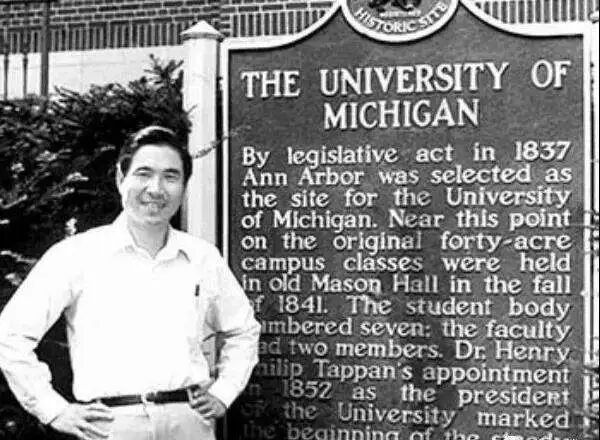
Driving behavior research has a long history. My doctoral advisor, Academician Guo Konghui, did pioneering work on driver behavior models and human-vehicle closed-loop system dynamics simulation as early as 1981, during his visiting scholarship at the University of Michigan. Driver models of that era mainly served vehicle handling-stability research, not automated driving.
More frequently cited in recent years are “driver reference capability models”, such as those defined in UNECE R157 and ISO 34502. These are mainly based on proving-ground testing — in a closed environment, with sampled drivers, tested against specific scenarios to derive key safety parameters. This work is valuable: it draws the safety floor.
But the scenarios a proving ground can cover are very limited. More than 99% of what human drivers face on the road every day is not those extreme cases. The throttle-application curve at pull-away, how following headway varies with speed, trajectory preferences through curves, how drivers negotiate with pedestrians and two-wheelers at intersections — this “normal” behavioral data is the real benchmark for human-like driving.
Proving-ground tests draw the floor of “safety”; naturalistic driving data draws the benchmark of “human-like”. Between those two lines is what intelligent driving ought to be.

2. Who Actually Needs This Answer?
Back to the question: who exactly benefits from knowing “how humans drive”?
Let me walk through the full life of an intelligent vehicle, from development to the road.
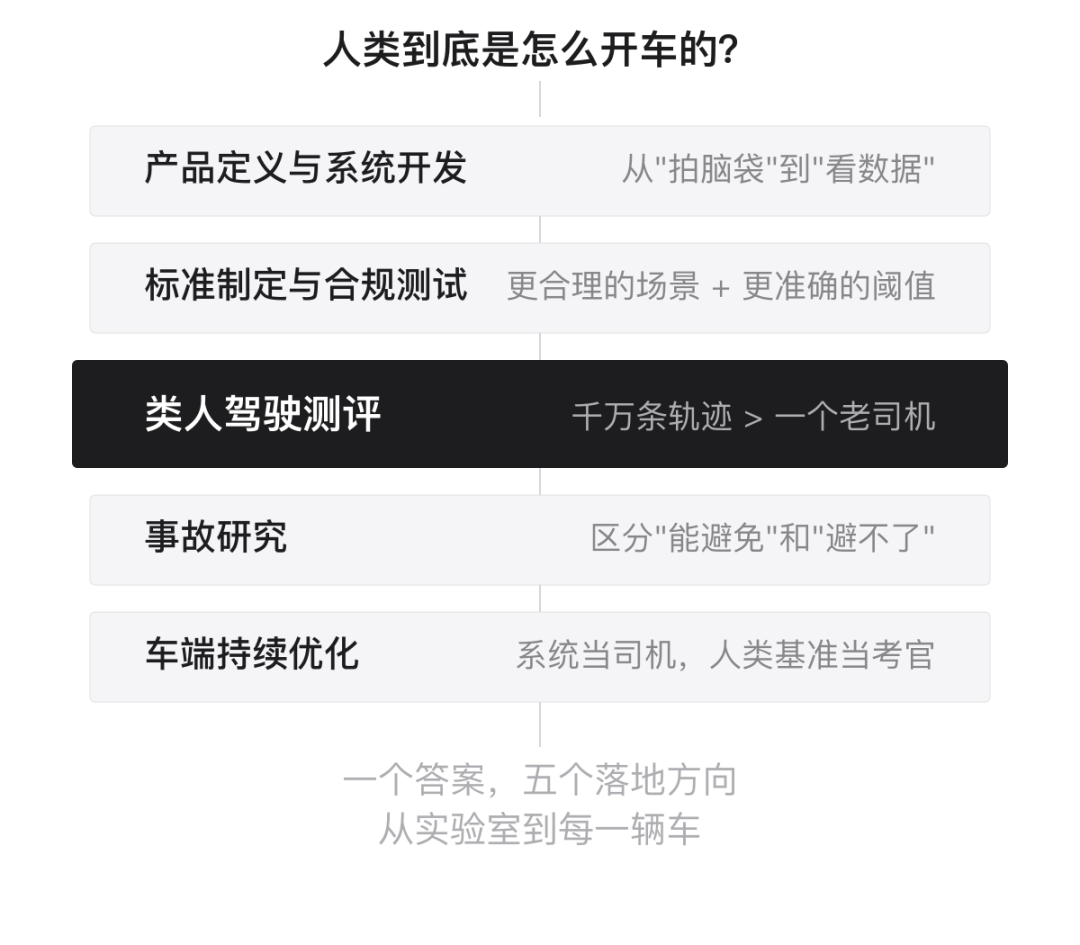
Product Definition and System Development
Across the intelligent-driving development chain, many roles need human driving behavior data as a reference.
The industry is rapidly converging on end-to-end approaches — perception, decision, and control are no longer separate modules but one large model learned end to end. Yet even in the end-to-end paradigm, a great deal of work still depends on the question “how do humans drive here”:
- Product managers defining feature boundaries: which scenarios must urban NOA cover? How much behavioral diversity do humans show in them?
- System and safety engineers drawing safety boundaries: how aggressive a cut-in must the cruising function handle? At what point does a cut-in exceed system capability?
- Data engineers curating training data: among oceans of vehicle-side data, which clips contain high-value human-vehicle interaction? What is the selection criterion?
- Test engineers defining acceptance criteria: how do you judge whether the trajectory output by an end-to-end model is “good enough”?
They are all facing the same question: how do humans actually drive in these scenarios?
As far as I can tell, many boundaries and criteria in practice are set by gut feeling, or by borrowing an incomplete number from the literature. After the vehicle hits the road and proves too aggressive or too conservative, the numbers get tuned again and again. Honestly, a lot of compromises get made.
With a sufficiently rich set of human driving behavior data — behavioral parameter distributions across speed bands, road types, and interaction scenarios — all of the work above can move from “gut feeling” to “reading the data”.
That is not an efficiency gain. It is an upgrade of the development paradigm.
Standards and Compliance Testing
Standards and regulations are the entry gate for intelligent driving. Set the bar too low and safety suffers; set it too high and compliance costs explode while progress stalls.
Proving-ground data can support standard-setting for a limited set of scenarios. But China’s traffic environment — high-speed cut-ins, mixed two-wheeler traffic, irregular junctions, ramp negotiations — is far more complex than a proving ground can reproduce.
Richer naturalistic driving scenario data, joined with physical proving-ground data, can help standard-setting along two dimensions:
First, better scenario selection. Which scenarios actually occur at high frequency on Chinese roads? Which look common but are in fact rare? With large-scale naturalistic data behind the statistics, the scenarios written into standards can reflect real roads, rather than expert intuition or isolated headline incidents.
Second, more accurate pass thresholds. Japan’s SAKURA project did excellent methodological groundwork here — its four-quadrant framing of “foreseeable/unforeseeable” and “preventable/unpreventable”, with a catalog of typical scenarios. But to draw the actual “preventability boundary” inside each concrete scenario — at a given speed band, how short a TTC means “no human could have reacted”, and how long a TTC means “any normal person could have avoided it” — you need large volumes of real data, not a line drawn by intuition.
Human-likeness Evaluation
This is, in my view, the most valuable and most imaginative application direction right now.
Existing assisted- and automated-driving regulatory tests focus mostly on safety: can the system detect the obstacle? Can it emergency-brake? These matter, of course — and OEMs and suppliers will use “various methods” to make sure production systems “pass” such scenarios — but the consumer’s experience goes far beyond them.
If you watch test-drive videos from intelligent-driving bloggers, these scenes will be familiar:
- On the highway with the system engaged, cars keep cutting in one after another from the next lane — the system yields every time, your anxiety builds, and eventually you take over.
- The road ahead is basically clear, yet the system is still cruising leisurely at 60 km/h — you tap the accelerator yourself, the speed comes up, and so does the experience.
- Through a wide-radius curve, the rhythm of steering corrections is not how you would do it — you can’t quite say what’s wrong, but it feels unnatural.
These scenes recur across livestreams and test-drive reviews. What’s interesting is that the bloggers and auto-executive hosts describe these problems almost entirely in subjective terms — “follows too far”, “hesitates in the curve”, “pull-away isn’t silky”. But exactly how much is “too far”? What does a “not silky” deceleration curve look like? There is currently no authoritative quantitative benchmark to answer these questions.
This is precisely what “human-like driving” has to solve. For consumers to genuinely trust and keep using intelligent driving, it must be not only “safe” but close to — or better than — human driving habits in comfort and throughput. And quantifying those dimensions has to be built on large-scale human driving behavior data.
Human-likeness evaluation doesn’t need “one veteran driver’s opinion”. It needs “the answer that ten million trajectories give you”.
Accident Research: Separating “Avoidable” from “Unavoidable”
Everything above is about forward development and evaluation. There is also a reverse application — learning from accidents.
Traffic accident data is a precious resource. But looking at the accident alone, it is hard to judge one key question: would a normal human driver have avoided this crash?
An example. A car is traveling normally on the highway when a stationary vehicle on the shoulder suddenly pulls into your lane — no veteran driver could react in time. If an intelligent driving system also fails to avoid the collision here, it should not be judged unqualified for that.
But in another case — the lead vehicle is clearly decelerating, the following distance is ample, and a normal driver could brake calmly — if the intelligent system rear-ends the lead vehicle there, that is a system problem.
How do you tell the two apart? You need a reference: what normal human drivers typically do in the same scenario.
This is exactly what large-scale naturalistic driving data provides. It records thousands upon thousands of normal driving behaviors — actual human reaction times, braking intensities, and avoidance strategies across speeds, gaps, and interaction scenarios. With that data, accident analysis gains an objective yardstick: what does this scenario look like in normal driving? How far did the behavior in the accident deviate from the normal baseline?
To be candid: our aerial-survey data is dominated by normal traffic flow, and extremely aggressive driving is rare in it. That means it is not well suited to directly defining absolute safety thresholds. But it is exactly what provides the “normal human driving baseline” — complementary to accident data.
Accident data tells you “what happened”; naturalistic driving data tells you “what normal should look like”. Only together can they tell whether a crash was the system’s failure or the scenario’s inherent limit.
Continuous On-Vehicle Optimization
The last application is integrating a human driving behavior model into the vehicle as a real-time reference.
Tesla fans will know “shadow mode” — the human drives while the system runs silently in the background, finding the places where “if the system were driving, it would act differently”, and sending those back as high-value data for iteration.
The application we have in mind runs exactly the other way: the intelligent system drives, and the human driving behavior model judges from the background. Through an intersection, how far does the pull-away rhythm deviate from the human baseline? How far does the cornering trajectory drift from human preference? Is the following distance at this speed band consistent with human habits? When the lead vehicle brakes, is the deceleration curve “silky” enough?
Tesla’s shadow mode is “human as teacher, system as student”. The human behavior model’s stance is “system as driver, human baseline as examiner”. They mirror each other, and both answer the same question: how far is the system from the human?
With such a reference, every OTA iteration of automated and assisted driving gains a clear optimization direction — not “I think it feels better”, but “the data tells me it drives more like a human”.
3. Four Paths to the Answer
Knowing the value of the answer, the next question is: how do you obtain it?
As far as I know, there are at least four approaches, each with its own emphasis.
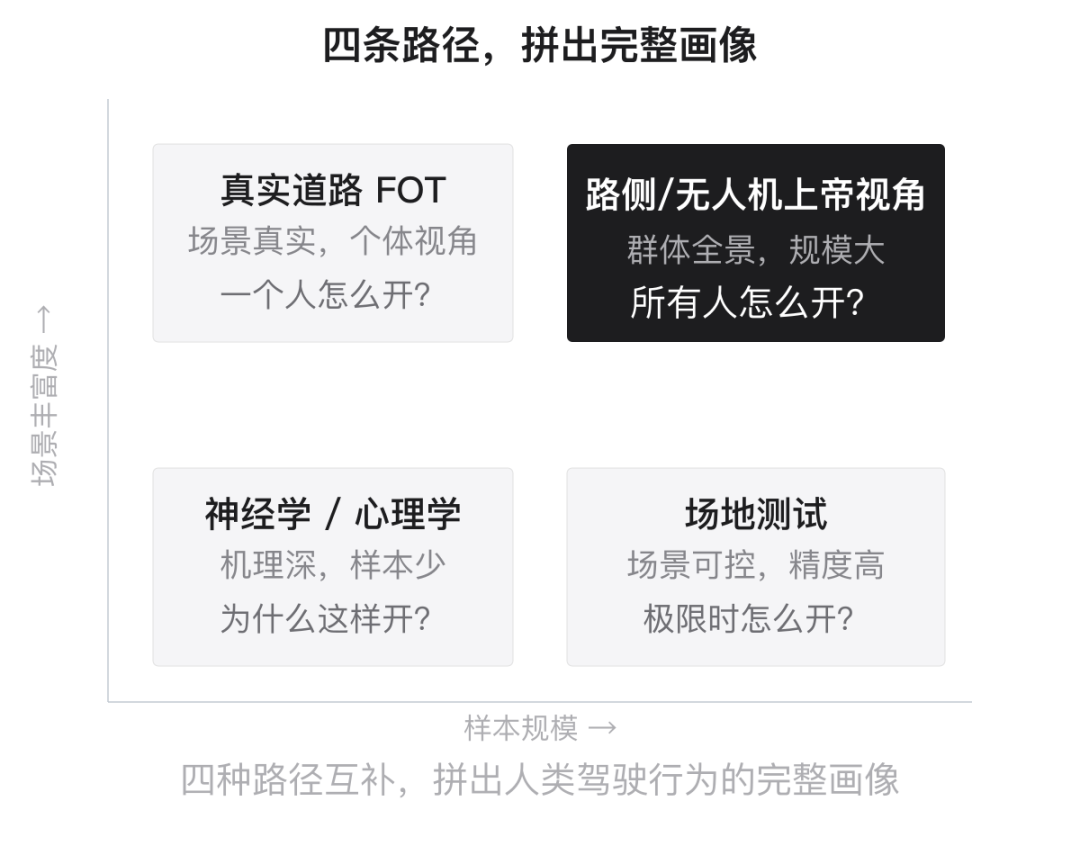
First: start from neuroscience and psychology. Instrument the driver — EEG, physiological signals, eye tracking — and reproduce scenarios in a driving simulator to dissect the psychological and physiological changes of driving. Professors Gao Zhenhai and Hu Hongyu at our college have deep foundations here, exploring from a human-factors angle the regularities of how intelligent driving systems make people feel safe and comfortable, feeding better design — which is also the essence of human-vehicle interaction and cooperation. This research typically produces mechanistic insight from typical-sample experiments, not large-scale statistical behavior models.
Second: physical proving-ground testing. In a closed facility, sample drivers across gender, age, and experience, test specific scenarios repeatedly, and extract key parameters. The driver reference capability models in Japan’s SAKURA project and UNECE R157 mainly came from this. “Controllability testing” in functional safety follows the same logic. The strength is controllable scenarios and precise data; the weakness is very limited scenario coverage.
Third: instrumented vehicles on real roads. Install sensors on production cars and track driver behavior on real roads over long periods. The China-FOT project led by Tongji University is the domestic pioneer and has produced a wealth of valuable results. The strength is real scenarios; but the capture is from the ego vehicle’s perspective — you only see your own driver’s behavior and the limited traffic ahead.
Fourth: roadside or drone-based bird’s-eye capture. From a light pole or from the air, capture the trajectories of dozens or hundreds of vehicles simultaneously. How humans pass signalized intersections, negotiate with pedestrians, merge from ramps, cut in and get cut in on in congestion, drive cautiously on ice and snow — it is all there, frame by frame.
These four paths do not substitute for one another. Neuroscience explains the “why”; proving grounds define the “safety floor”; FOT captures “individual depth”; the bird’s-eye view covers the “population panorama”. Together they assemble the full portrait of human driving behavior.
The distinctive value of aerial-survey data is its efficiency and breadth. It captures the behavior of every participant in everyday traffic — not the depth of one driver, but the statistical regularities of ten million trajectories. For answering “how do humans actually drive across scenarios”, it may be the broadest-coverage, most cost-efficient path.
An Unavoidable Question: In the End-to-End Era, Is Bird’s-Eye Data Still Useful?
At this point, an honest answer is owed to a question many people in the industry quietly hold.
Intelligent driving is rapidly converging on data-driven end-to-end approaches. The “data” in “data-driven” is overwhelmingly vehicle-side data — massive perception data from cameras, lidar, and radar. Vehicle-side data is already enormous, and making full use of it is, of course, the core means of training and improving end-to-end systems.
Hence the natural doubt: with so much vehicle-side data, is drone-based bird’s-eye naturalistic data — lacking the ego view, offering only overhead trajectories — still necessary?
My view: vehicle-side data answers “how should the system drive”; aerial data answers “how do humans drive”. These are two different questions.
Vehicle-side data trains the system’s perception and decision capability — what it sees, how it reacts. Aerial data provides an external reference frame — what humans actually do in the same scenarios. The former makes the system able to drive; the latter judges whether the system drives like a human.
Another challenge is more practical: end-to-end models trend toward black boxes. The thresholds that system engineers and product managers define from human driving behavior — following headway, pull-away latency, cornering speed — how do you inject them into an end-to-end model? This is not solvable by simply “writing in a rule”.
But flip it around: precisely because end-to-end models are increasingly black-box, judging from the outside whether they “drive like a human” becomes more important. You cannot open the box to inspect the parameters, but you can measure the deviation between its output behavior and the human baseline. The role of human driving behavior data here is not training data — it is the evaluation benchmark.
End-to-end solves “how to drive”. But judging “how well it drives” will, in the end, need a yardstick that comes from humans.
4. What We Are Doing, and What Comes Next
What my team and I have been doing for the past several years is walking down that fourth path.
We have accumulated 700+ hours of aerial-survey data and extracted more than 10 million behavioral trajectories, covering highways, urban expressways, ramps, intersections, roundabouts, ice-and-snow roads, and more. Collection sites span 10+ cities including Changchun, Shenzhen, Wuhan, and Xi’an, with new sites selected to capture the driving character of different regions of China.
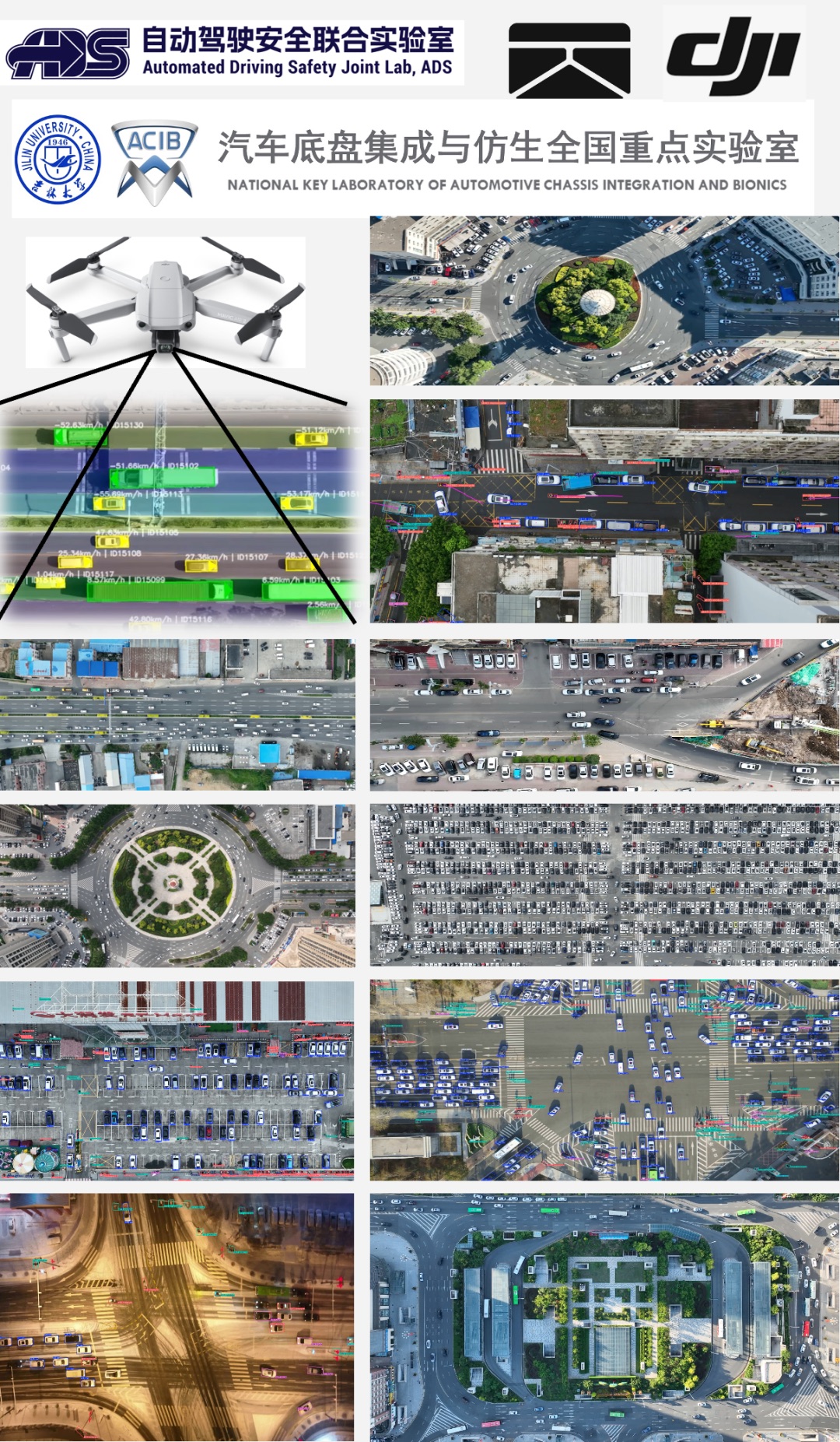
On this data we are training a “Chinese Driver Foundation Model” — input the scenario parameters, output the predicted behavior and parameter distributions of human drivers in that scenario. It is hard but meaningful work, because it turns the answer to “how do humans drive” from scattered data into a model that can be called.
On the application side, we are already working with partners in several directions:
- With Zhuoyu Technology: extracting hazard-scenario metrics (TTC, THW, etc.) for highways and expressways from aerial data, converting dynamic agents and static maps from the trajectory dataset into high-fidelity 3DGS assets, and running closed-loop simulation verification of end-to-end algorithms — the key step that takes aerial data from “visible” to “usable”.
- With Pan Asia Technical Automotive Center: exploring how large-scale naturalistic driving data supports SOTIF-oriented forward development of high-level automated driving systems — helping development engineers move from “gut feeling” to “reading the data”.
- On the academic side: together with researchers from Jilin University, Tongji University, Heriot-Watt University, and Durham University, building the Chinese Driver Foundation Model on large-scale naturalistic data — providing multi-dimensional human behavior baselines (perceived safety, comfort, throughput) for the “human-likeness” of intelligent driving.
- With the Road Traffic Safety Research Center of the Ministry of Public Security: exploring the complementarity of naturalistic baseline data and accident data — accident data records “what happened”, naturalistic data shows “what normal looks like”, and only together can they tell a system failure from a scenario’s inherent limit.
- With the leveLXData team under fka (Aachen, Germany): a data partnership. leveLXData is the pioneer of aerial naturalistic data, with 400+ hours collected across 139+ locations in Europe and North America. One core purpose of our collaboration is comparative analysis of Chinese and international driving behavior.
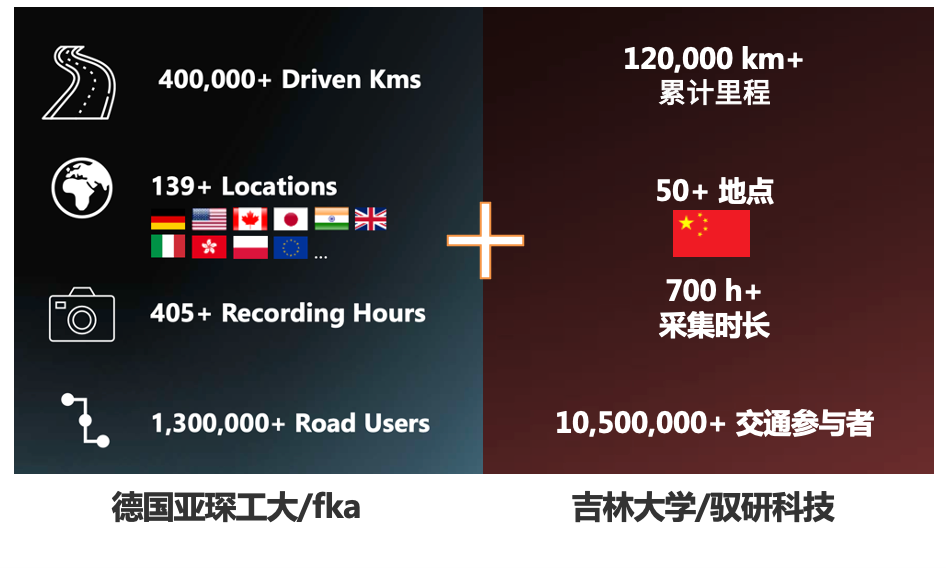
One point deserves emphasis: research on “how humans drive” must start from the target market. Driver behavior differs enormously across countries and regions — car-following habits on Germany’s unrestricted autobahns, the courtesy choreography of America’s four-way stops, China’s high-frequency cut-ins and mixed two-wheeler traffic. “Cultural difference” does not begin to cover it; each difference maps to different safety boundaries and different human-likeness baselines. Evaluating a Chinese intelligent-driving system with German behavioral data, or vice versa, will produce wrong conclusions. This is why we insist on collecting and studying naturalistic driving data native to China.
The next important thing we plan to do: open-source more trajectory data and parameter distributions for typical scenarios.
Open-sourcing sample data and parameter distributions for typical scenarios — for example, TTC and headway distributions of human drivers across speed bands in highway car-following. Researchers can use them directly for algorithm validation and paper benchmarking; engineers can judge whether this kind of data is relevant to their work.
But every company’s system faces a different Operational Design Domain (ODD), different functional scenarios, and different parameter dimensions and precision needs. An urban-NOA company and a highway-HWP company need entirely different scenario types; an AEB calibration engineer and an end-to-end training engineer care about different behavioral parameters. Customized analysis for a specific ODD, function, and metric requires deep mining of the full dataset — something open samples cannot replace.
We hope open-sourcing lowers the barrier for the whole industry to use naturalistic driving data. The answer to this question is too important to stay locked on any single institution’s hard drive. Let more people see the value of the data first, and more people will help complete the answer.
In fact, our team already has several open-source releases:
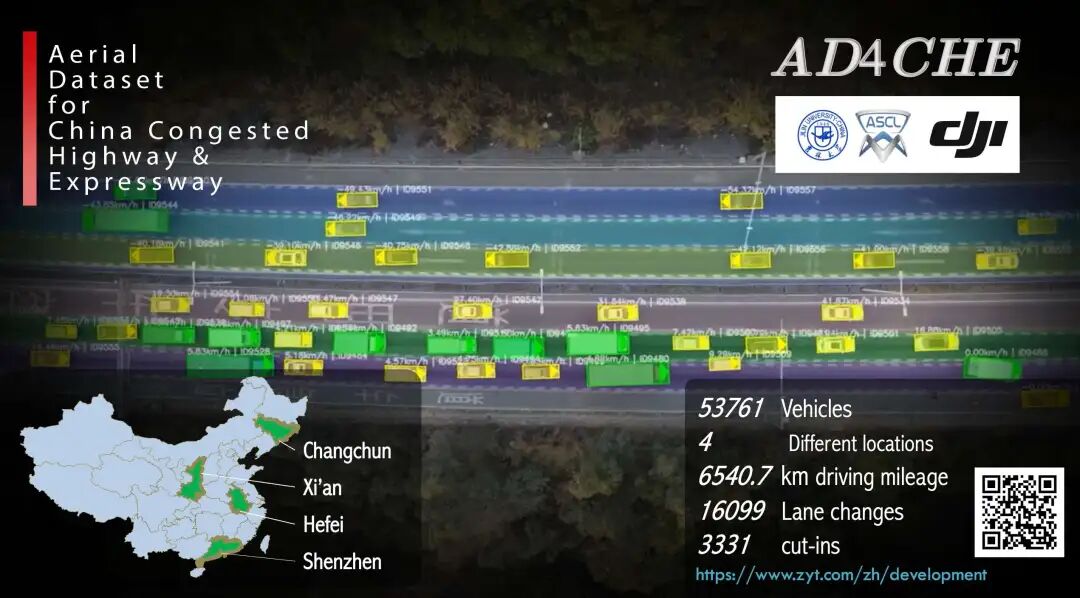
AD4CHE (Aerial Dataset for China Congested Highway and Expressway): built to serve Volkswagen China’s Rush Hour Pilot project (especially close-range cut-ins in congestion), open-sourced together with DJI Automotive (Zhuoyu Technology), covering congested scenarios on Chinese highways and expressways. More than 400 institutions worldwide have applied to use it.
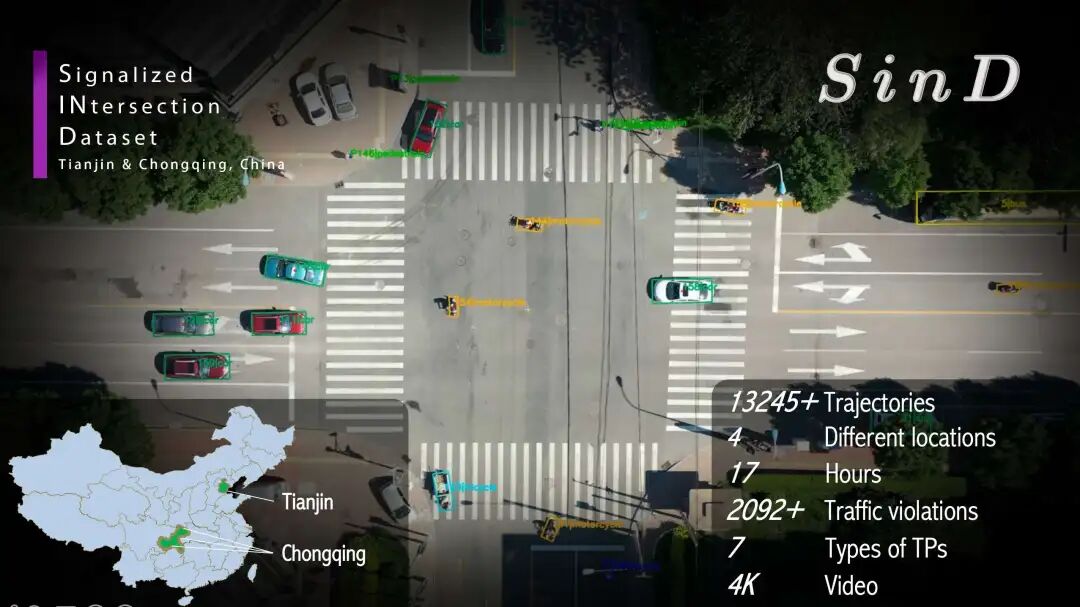
SinD (Signalized Intersection Dataset): led by Prof. Wang Hong of Tsinghua University with our support, an aerial dataset of signalized intersections covering multi-vehicle and vehicle-pedestrian interactions across full signal cycles.
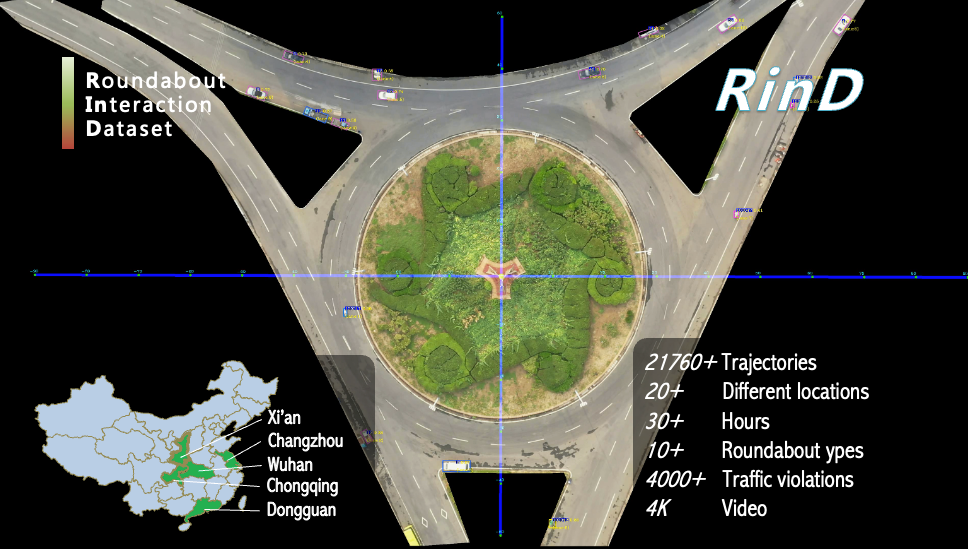
RinD (Roundabout Interaction Dataset): led by Prof. Li Chuzhao of Chongqing University with our support, an aerial dataset focused on human-vehicle interaction in complex roundabout configurations.
VRUD (Vulnerable Road User Dataset): an aerial dataset dedicated to scenarios where motor vehicles mix heavily with vulnerable road users (pedestrians, two-wheelers).
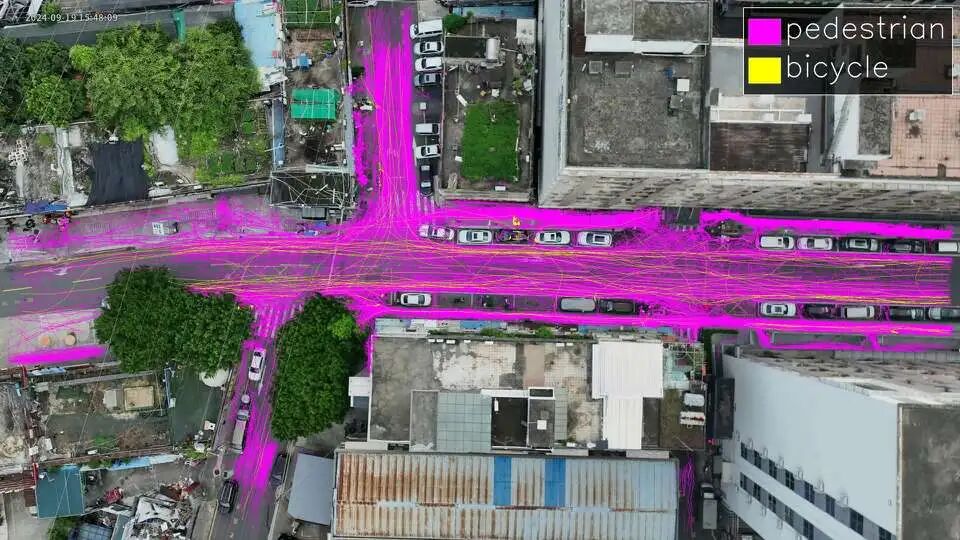
Coming next is an ice-and-snow road dataset — driving behavior on low-friction winter roads in Northeast China: how humans follow, brake, and corner on ice, and how that differs from the same road sections in normal conditions. More themed datasets — complex roundabouts, work zones, accident-prone sections — are being planned.
Every release shares one more cross-section of the answer to “how do humans actually drive” with the whole industry.
Coda
Having written this far, look back at the human-behavior studies at the start.
We study children’s behavior so parents have an easier time. We study mate selection to find the right person. We study how humans drive so that every intelligent vehicle better understands what “driving well” means.
Study “human” driving behavior; achieve “human-like” intelligent driving. The road is long, but the direction is clear.
That said, my study of how humans drive is not armchair work. With a dozen-plus years behind the wheel, I have driven an RV (doubling as a data-collection vehicle) from Changchun to Shenzhen to Yunnan, back from Shenzhen to Changchun and into Inner Mongolia, from Heilongjiang to Beijing… Several loops across China, with plenty of unusual road conditions experienced firsthand. I have also “negotiated” with local drivers in the old towns and mountain roads of a dozen countries across North America and Europe — each time wondering: facing the same curve, the same cut-in, how do driver behavior patterns differ across countries? An occupational disease, I suppose — studying how humans drive while driving.
But the more I drive, the more I believe one thing: a good driver and a good intelligent driving system need, at bottom, the same things — an understanding of the road, anticipation of risk, and respect for every person inside and outside the vehicle.
We will keep walking this road.
Previous Posts
- In the End-to-End Era, Does Scenario-Based Safety Evaluation Still Work?
- Whom Should Automated Driving Drive Like? The Driver Foundation Model’s Answer (in Chinese, WeChat)
- Scenario-Rich Aerial Survey Datasets (in Chinese, WeChat)
For future data releases, follow DRIVEResearch: driveresearch.tech