It happened in Shanghai.
On 5 September 2026, during a China GT race, a car was caught in a multi-car collision, caught fire, and the driver was trapped in the cockpit.
The first person to reach him was not a firefighter. It was not a medical team. It was another racing driver. He stopped, ran across, took a fire extinguisher, tore away damaged bodywork, and pulled the trapped driver out.
Public reporting puts the time from fire to rescue at around 49 seconds.
That number is not especially long. The uncomfortable part is that the rescue should have been performed by the track safety system, not by a driver who was still competing.
The accident quickly entered the international media. Many questions are now being asked about event management, red-flag timing, the late ambulance, and whether track staff were trained well enough. I want to look at it from a slightly different angle.
It is not only a motorsport management case. It is an early sample of a systemic problem.
1. Racing safety is not one person’s courage
Many people still understand motorsport safety through helmets, fireproof suits, HANS devices, the halo, and roll structures.
Equipment matters. But a real track accident tests a whole chain.
In its high-voltage racing safety framework, the FIA repeatedly emphasizes that roles and responsibilities must be fixed before technology. Its three operational pillars are an on-site e-safety delegate, a dedicated race-control coordination link, and a technical system expert who can quickly judge whether a car is safe.1
In other words, a mature event decides in advance who judges, who directs, who approaches the car, who fights the fire, and who hands the injured driver to the medical car.
A recent FIA University medical and safety white paper goes further. It formalizes the on-scene rescue commander role as Rescue Chief and plans mandatory pre-hospital qualifications for certain senior FIA medical personnel by 2026.2
These terms sound like organization management, but their value is concrete. The biggest risk at an accident scene is not that nobody wants to help. It is that everyone rushes in, but nobody knows the next step.
The DMSB Academy has held international medical training days at the Nürburgring. Participants include doctors, medical-car drivers, rescue crews, and emergency teams from several countries. The training includes extrication on real racing cars and Race Track Trauma Life Support.3
The goal is not to turn people into heroes. It is to turn firefighting, approach, stabilization, extrication, and transfer into practiced roles that do not need to be debated at the scene.
That is the real moat of motorsport safety.
2. Chain collisions have no single answer, but layered design
If we treat this accident only as a single car catching fire, we miss a larger point. It was a multi-car collision.
Motorsport does not have a unified certification called a “three-car chain collision.” FIA crash certification separates front, side, rear, roll structure, and steering column into individual static and dynamic tests.45
Interestingly, some certification work is repeated on a structure that has already been damaged. The logic is clear: after the first impact, the car must still be able to absorb later impacts.
That is the closest thing to chain-collision design.
On top of it, motorsport uses many layers to reduce secondary and tertiary risks.
| Risk | Typical design |
|---|---|
| Multiple impacts crushing the cockpit | Survival cell, front and rear impact structures, side intrusion protection |
| Repeated acceleration and deceleration injuring head and spine | HANS, headrest, racing seat, multi-point harness |
| Wheels or parts striking the driver in a later impact | Halo, wheel tethers, secondary roll structure |
| Post-crash fire or electric shock | Fuel-cell isolation, high-voltage isolation |
| Car rebounding from a barrier into the racing line | TecPro and similar energy-absorbing barriers |
| A car becoming airborne while spinning in dense traffic | NASCAR roof flaps and A-post flaps |
These designs were not invented at once. They were added gradually after many real accidents.
These layered designs can be seen in FIA crash certification, track barriers, Formula E wheel-tether rules, and NASCAR anti-lift devices.45678
3. A racetrack problem becomes harder for driverless vehicles
I have been watching high-level automated-driving safety for the past few years. When I saw the Shanghai accident, my first thought was not about motorsport itself. It was about another question.
When a future robotaxi or driverless logistics vehicle is involved in a multi-car collision, who will be the person running toward the scene?
The answer may be: no one.
A traditional traffic accident still has a driver. The driver can get out, check injuries, call for help, and tell emergency workers whether anyone remains inside, where the fuel or battery system is, and whether the door can open.
In a driverless vehicle, that immediate information may not come from anyone.
This is exactly the problem NHTSA publicly described in July 2026. It documented driverless automated vehicles driving into active emergency scenes, blocking ambulances and fire trucks, or failing to recognize flashing lights, smoke, fire, and traffic cones.9
The lesson is not that one company failed. The lesson is that incident-scene management is still a weak link in the automated-driving safety lifecycle.
SAE AVSC has published a best practice for first-responder interactions with fleet-managed ADS-dedicated vehicles. It begins to address vehicle identification, occupant detection, high-voltage and fire handling, towing, and fleet-operator coordination.10
The direction is right. But publishing a guideline is not the same as proving that a fleet has implemented it as a verifiable capability.
4. Why traditional NCAP cannot cover chain collisions
There is another common misunderstanding: crash testing.
Euro NCAP crash protection does include a full-width rigid barrier, a mobile progressive deformable barrier, a side moving deformable barrier, a side pole, far-side occupant protection, and whiplash tests.11
But they are not one three-car crash. Frontal is frontal. Side is side. They are completed on separate identical vehicles.
China C-NCAP is similar. The 100% rigid barrier, 50% MPDB offset, side barrier, and side pole are independent tests.12
The “three-car double impact” or “three-car chain collision” events seen in public media are mostly extra challenges by CATARC or automakers, not routine NCAP rating items.
The Audi E7X multi-car random crossroad impact belongs to this category. It verifies vehicle-level passive safety. It does not verify the operational safety of an automated-driving system under multi-agent interaction, communication loss, and post-crash secondary collisions.13
Those two problems should not be mixed.
Euro NCAP 2026 adds an important direction: Post-Crash Safety. It requires multi-collision braking and automatic hazard activation after a first impact, in order to reduce secondary and tertiary collisions.11
That is much closer to active prevention of chain collisions. But it is still not a passive-safety test in which the same vehicle receives multiple-direction impacts at once.
5. First protect the driver, then manage the cars behind
Motorsport safety has already moved beyond protecting the driver in the first impact. It now also asks how later cars and responders can be kept safe.
This shift matters.
Older motorsport safety centered on the driver: fireproof clothing, HANS, the halo, the survival cell, and roll structures all protect the person in the cockpit. Today, the FIA high-voltage safety framework also brings together an on-site e-safety delegate, a race-control link, and a technical system expert to judge whether a crashed car is still energized, whether it is safe to approach, and whether it may affect later vehicles or responders.1
The 2020 Grosjean accident in Bahrain is often cited. Public reports say the car caught fire after impact, a red flag was shown roughly five seconds later, and the medical-car crew was in place around 28 seconds after impact, following pre-assigned roles for firefighting, approach, and medical preparation.17
The point is not any single number. The point is that the scene did not depend on a passing driver making an improvised decision.
For automated driving, the problem escalates.
After a conventional crash, the driver can get out and say whether anyone remains inside, whether a door is jammed, and whether the powertrain is still active. In a driverless vehicle, that information must come from the vehicle itself, a remote operator, or external identification systems.
Without advance design, the scene becomes an information vacuum.
This is no longer an extension of passive safety. It is a post-crash coordination system.
6. What automated driving lacks is not another crash
If automated-driving safety is viewed as a lifecycle, multi-vehicle chain collisions are currently scattered across several places, but not treated as a single objective.
At the risk-identification stage, we are used to analyzing pairwise interaction between one ego vehicle and one target vehicle. We are less used to analyzing how risk propagates through a chain of vehicles.
At the safety-design stage, fleet-level status broadcasting and a standard interface for a crashed vehicle to declare its state to nearby vehicles and emergency responders are still missing.
At the safety-testing stage, it is easier to test whether a single vehicle can stop, and harder to test whether multiple vehicles amplify each other’s risk.
At the post-crash stage, coordination among remote operations, emergency services, and traffic management still lacks a standardized process.
Work has started in China.
I am leading a China-SAE group-standard pre-research effort on abnormal-event handling for highly automated vehicle operations. It involves scenario classification, responsibility matrices, first-responder interaction plans, and verification methods.14
That is a positive signal. But it is still in pre-research, and there is distance between a pre-research project and a complete, deployable practice.
Methodologically, ISO 34502 provides the functional-logical-concrete scenario hierarchy that can turn multi-vehicle interaction into testable scenarios. UL 4600 also allows the assessed item to be a fleet or platoon, not only a single vehicle.1516
The problem is not that standards have no opening. The problem is that industry practice and public research are still vehicle-centric.
7. Standards have opened a door, but industry has not connected the line
To understand the gap, it helps to scan the current standards and industry signals.
| Framework or signal | What it already provides | What remains missing |
|---|---|---|
| ISO 21448 SOTIF 18 | A framework for known and unknown unsafe scenarios | Multi-vehicle coupling and trigger-condition identification remain mostly vehicle-centric |
| ISO 34502 15 | Functional, logical, and concrete scenario layers | Systematic generation and risk ranking of multi-participant scenarios |
| UL 4600 16 | Allows the item to be a fleet or platoon | Fleet-level safety cases remain rare |
| SAE AVSC 10 | First-responder best practice for L4/L5 fleets | Distance remains between guidance and verifiable deployment |
| NHTSA public call 9 | Documents failures of driverless vehicles interacting with responders | Standardized incident-scene coordination is missing |
| Euro NCAP 2026 11 | Post-Crash Safety with multi-collision braking | Still not a simultaneous multi-direction crashworthiness rating |
| C-NCAP 12 | Independent frontal, offset, side, and pole tests | Three-car double impacts remain extra challenges |
| My group-standard pre-research 14 | Abnormal-event handling framework for highly automated operations | Still in pre-research |
At first glance, this table looks encouraging because every direction has opened a door.
The real problem is that these doors are not connected into one line.
Scenario engineers care about generation, operations teams care about response flows, crash engineers care about occupant protection, and standardization experts care about clauses. All four groups are working on part of a chain collision, but few are using one line that connects risk identification, safety design, safety testing, and post-crash handling.
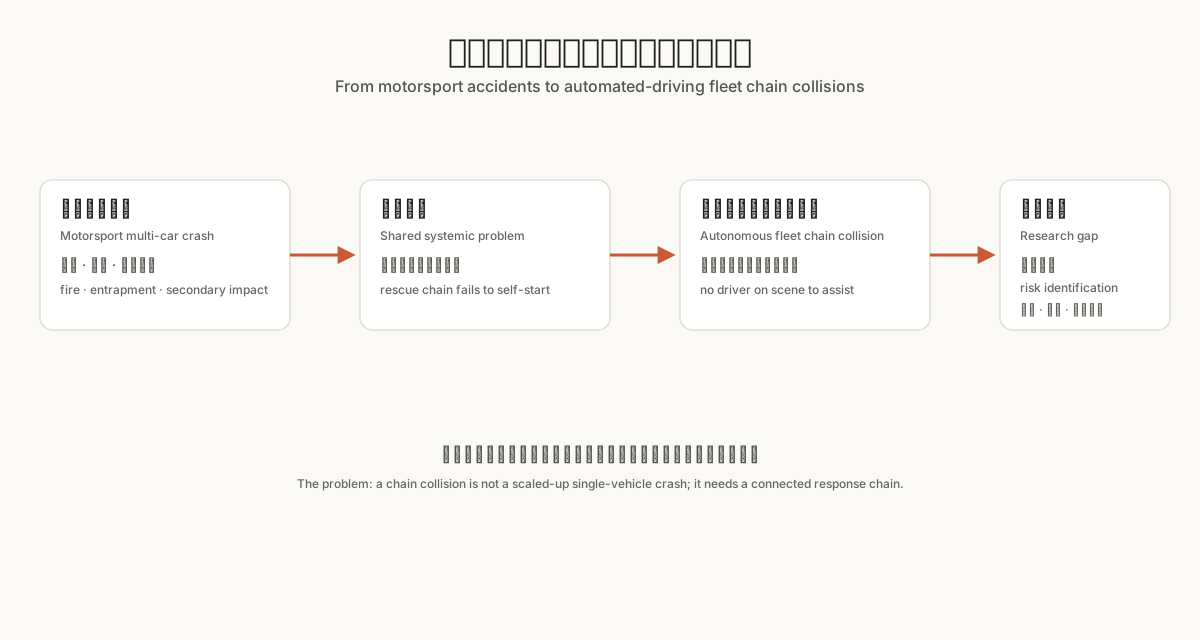
That is the lesson of the 49 seconds in Shanghai. The problem was not that tools were missing. It was that the tools did not form a chain that started automatically at the critical moment.
Automated-driving safety is the same. We cannot only pursue more tests for a single vehicle. We also have to ask whether the whole chain can reduce risk after the first impact.
So the next piece of work is not to invent another isolated metric. It is to connect existing frameworks with real data and make chain collisions computable, testable, and verifiable for the first time.
8. With data, these questions are no longer guesses
Some people will ask whether these ideas can move from “feels important” to “computable, testable, and verifiable.”
My judgment is yes.
Over the past few years, our lab has accumulated aerial naturalistic driving data, currently in the range of 1000 hours and more than 12 million traffic-object trajectories. The value of this data is that it is not a designed test scenario. It is multi-vehicle interaction as it actually happens on real roads.
It can help answer several questions that are still not fully answered.
First, how common is multi-participant interaction? Much safety analysis still treats one ego vehicle and one target vehicle as a pair. But real roads contain many moments when a vehicle is being cut in on, following a braking lead, and watching an adjacent-lane vehicle approach at the same time. We need to know how often three-, four-, and higher-participant coupled scenes occur in urban and highway environments.
Second, how does multi-vehicle risk propagate? A lead vehicle brakes, the follower brakes, the next follower changes lane, and risk is transferred to the adjacent lane. This is not a collection of independent pairwise relationships. It is a time-ordered chain. We can use TTC, PET, and DRAC to measure how risk spreads across space and time.
Third, which scenes deserve priority? Multi-vehicle conflict samples are sparse in naturalistic data, so we cannot test everything. We can first find high-frequency, high-risk, high-coupling scene clusters, then convert those scenes into OpenSCENARIO test cases.
Fourth, how should post-crash coordination be designed? After a vehicle stops, how should it declare its position, occupant presence, and isolation state? What information do remote operations, fire, rescue, and traffic management need? These questions can first be grounded in data and then turned into product design.
ISO 34502 gives the scenario hierarchy. UL 4600 allows a fleet to be assessed as a whole. What is missing is the connection between these frameworks and real data.1516
If we break the work into claimable packages, they look like this.
- Multi-vehicle interaction mining: extract conflict clips involving three or more participants from aerial data and measure interaction degree.
- Chain propagation modeling: analyze the time ordering and risk diffusion among lead braking, follower response, and adjacent-lane lane changes.
- Test scenario generation: convert high-frequency, high-risk scene clusters into OpenSCENARIO cases for simulation and proving-ground testing.
- Post-crash coordination design: define the state information that vehicles, remote operators, fire, rescue, and traffic management need to exchange.
- Evaluation metric research: build acceptance methods that check not only whether one vehicle stops, but also whether multiple vehicles amplify each other’s risk.
This is why I want to turn it into an open research topic. The data and methods already have a starting shape, but they need more people to make them reproducible and verifiable research assets.
9. I plan to make this an open research topic
At this point, the subject has outgrown what a short commentary can carry.
It needs someone to define the problem carefully, to calculate how common multi-participant interaction really is, to turn chain collisions into reproducible scenario libraries, and to verify post-crash coordination.
So I will add a full open topic to OpenTopic.
The working title is multi-agent interaction and chain-collision safety for automated driving.
It will not be a polished concept document. It will try to provide research questions, data basis, methods, metrics, work packages, and translation paths.
I know one research group cannot finish this alone. But a good question should not stay locked in a drawer simply because there are not enough people.
That is also why I have been building OpenTopic. Data can be open. Research ideas should be open too.
Finally
Those 49 seconds in Shanghai exposed a rescue chain that did not automatically start when it was needed.
For automated driving, the reminder is this: the hardest problem is not teaching one vehicle to avoid a crash. It is enabling a group of vehicles, a fleet, and an emergency response system to coordinate after the first crash, protect people, and get information to the right actor.
Those 49 seconds should not have depended on one driver.
On future roads, we should not wait for a hero who happens to be nearby.
The open research topic is here: OpenTopic.
If you work on multi-agent interaction, scenario generation, fleet operations, or post-crash emergency response, I hope you will carry it forward.
References
[1] FIA, Safety Charge: How the FIA is leading the way in high voltage racing, 2026-02-04. https://api.fia.com/news/safety-charge-how-fia-leading-way-high-voltage-racing
[2] FIA University, Working for Safety: Medical and Research-Driven Advances in Motor Sport Safety, 2026-04-15. https://api.fia.com/news/fia-university-launches-working-safety-white-paper-medical-and-research-driven-advances-motor
[3] FIA / DMSB Academy, International Medical Training Days at the Nürburgring, 2017-02-21. https://api.fia.com/news/international-medical-training-days-nurburgring
[4] FIA, Breaking the barriers of safety, 2013-05-28. https://api.fia.com/news/breaking-barriers-safety
[5] Formula 1 car testing regulations and load cells, 2024-03-30. https://www.loadcellshop.co.uk/load-cell-uses/how-to-test-your-new-f1-racing-car/
[6] TecPro Barriers: F1 Track Safety, 2026-05-14. https://f1briefing.com/tecpro-barriers-improve-f1-track-safety/
[7] FIA Formula E 2026-2027 Technical Regulations, wheel tether requirements. https://www.fia.com/system/files/documents/2026-2027_season_13_formula_e_techregs_wmsc_10.12.2025_eng_fr_v17.pdf
[8] NASCAR A-post flap safety update, 2025-08-21. https://thesportsrush.com/nascar-news-everything-about-the-a-post-flap-that-nascar-will-debut-at-daytona/
[9] NHTSA, An Automated Vehicle That Cannot Safely Interact With First Responders is a Danger to the General Public, 2026-07-08. https://www.nhtsa.gov/press-releases/av-developers-automated-vehicle-that-cannot-safely-interact-first-responders-danger
[10] SAE AVSC, AVSC Best Practice for First Responder Interactions with Fleet-Managed ADS-DVs, 2024-04-04. https://avsc.sae-itc.org/Global/FileLib/SAE_International/AVSC-I-01-2024_pd_04.02.24_JG_FINAL_4.03.24_bam_clean.pdf
[11] AVL, Euro NCAP 2026: What’s Changing and How to Stay Compliant, 2025-10-22. https://www.avl.com/en/blog/euro-ncap-2026-whats-changing-and-how-stay-compliant
[12] MarkLines, NCAP (New Car Assessment Program) Overview and Activities (1), 2022-11. https://www.marklines.com/cn/report/rep2396_202211
[13] Audi E7X completes the industry’s first multi-car random crossroad impact, public automotive media report, 2026-04-14. https://www.toutiao.com/article/7628873761420263979/
[14] China Intelligent and Connected Vehicles Industry Innovation Alliance, Standard pre-research: abnormal-event handling for highly automated vehicle operations, 2026-05-12. https://mp.weixin.qq.com/s/hQiBeE37qpUqKCRHsJZHjQ
[15] ISO 34502:2022, Road vehicles — Test scenarios for automated driving systems — Scenario based safety evaluation framework. https://www.nen.nl/norm/pdf/preview/document/303466/
[16] UL Standards & Engagement, UL 4600 Ed. 3-2023 scope summary, 2023-03-16. https://webstore.ansi.org/standards/ul/ul4600ed2023
[17] Speedcafe, FIA concludes investigation into Grosjean crash, 2021-03-05. https://speedcafe.com/fia-concludes-investigation-into-grosjean-crash/
[18] ISO 21448:2022, Road vehicles — Safety of the intended functionality. https://www.iso.org/standard/77490.html