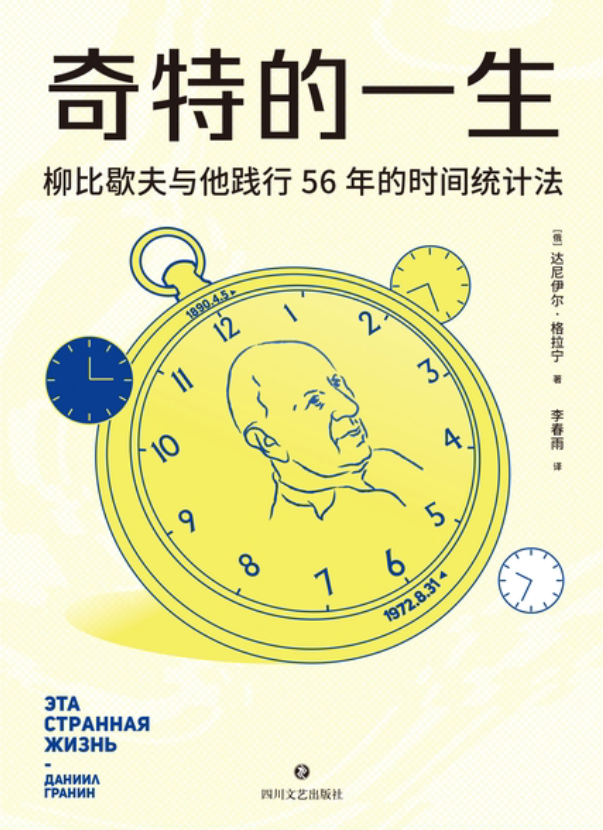
A Strange Life (Эта странная жизнь) is a Soviet documentary novella written by Daniil Granin, first published in 1974. It tells the life of Soviet entomologist, philosopher, and mathematician Alexander Lyubishchev. Lyubishchev pioneered and practiced his own time-accounting method, using it as both research instrument and personal experiment — for 56 years, beginning at age 28, recording every block of time he spent and continuously refining the system. By organizing Lyubishchev’s diaries and time ledgers, Granin reconstructed the life of this pioneer of personal time management. — Baidu Baike
1. A Strange Man, 56 Years of Recording
Granin opens A Strange Life with an unforgettable scene.
In 1972, Lyubishchev died, and several distinct groups of mourners showed up at the funeral. Biologists came to bid farewell to a peer; entomologists came to send off an authority; mathematicians came to mourn a correspondent; there were also historians of science, evolutionary theorists, philosophers — and the strange thing was, most of them did not know each other.
But every group was convinced that Lyubishchev had been a first-rank figure in their field.
This Soviet scientist, born in St. Petersburg in 1890, was by training an agricultural entomologist — specializing in a complex taxonomic group called the Galerucinae (leaf-beetle subfamily, jumping-flea tribe).
But his work crossed boundaries. Across an 82-year life, he published roughly 70 academic books spanning entomology, biological taxonomy, genetics, mathematics, philosophy, and the history of science — leaving behind more than 12,500 pages of manuscripts. A genuine slash-career man, generations early.
How did he do it? Granin’s answer is not talent. It is that this man, starting on January 1, 1916, began writing down on paper how every block of every day was spent — what task, how many minutes. Daily reckoning. Monthly reckoning. Yearly reckoning. He kept it up for 56 years, still doing it the week before his death.
I read this book six or seven years ago. At that point in my life, my work had stopped being single-stream — multiple projects in parallel, a great many pre-research areas I wanted to chase, undergraduate and graduate research advising, materials for a brand-new course, standards-and-regulations participation… No single piece was hard. The aggregate, every evening, felt like time dissipating — at the end of the day I genuinely could not say what I had done.
What hit me about the book at the time was not the 70 books or the 12,500 pages — those are outcomes. It was this passage:
Time-accounting became the skeleton of Lyubishchev’s life — useful for productivity, but more importantly for staying alive in his work. Beyond the accounting itself, Lyubishchev followed several rules: take on no obligations you must complete; refuse anything urgent; the moment you feel tired, stop and rest; sleep about ten hours; pair tiring work with pleasant work.
But Lyubishchev’s time-accounting method has one cost almost no one can pay: 30 minutes of manual accounting, every single day.
So I went looking for tools.
2. Years of Hunting for Tools, Years of Uninstalling Apps
I tried aTimeLogger. Press the timer, switch task, press, switch. Sometimes I forgot to start, sometimes I forgot to stop. My phone would lock and a half-hour later I’d still think I was deep in focus.
I tried Toggl. Desktop and mobile sync. The sync itself became another thing I had to manage.
I also kept a paper notebook for a stretch. I lasted under three weeks.
Every failure left me a little dispirited. Maybe my self-discipline or follow-through is just too weak?
But eventually I worked something out: the paradigm of these tools is wrong.
They ask the human brain to do what the computer should do — press buttons, switch labels, write the record. Lyubishchev had no other choice — pen and paper was all there was. But for me, in the 21st century, copying that part of his method literally turns my brain into a 19th-century stopwatch.
The Chinese editions of the book include attempts by various practitioners — Qiu Ye who runs PowerPoint training, Li Xiaolai of Treat Time As Your Friend, and others. Reading them, none had found a once-and-for-all solution. Each had a workable compromise; each compromise required ongoing daily discipline.
I never found the right tool. But I never gave up either.
3. Recording is the Leaf; Planning is the Trunk
What eventually clicked: what Lyubishchev really gave me wasn’t “record every minute.” It was the other side:
He didn’t just record — he planned.
Read his biography and you find: beyond the daily accounting, a small weekly review, a medium-sized monthly review, a big yearly review. Above that, a 5-year plan. And above that, “the question I want to answer with my life” — as the topmost anchor.
Recording is the leaf of this system, not its trunk.
I never found the recording tool, but I started building the planning chain. First a paper notebook, then OneNote, eventually XMind for mind-mapping. A mind-map is better than text for someone whose work has many cross-referenced threads — it makes decomposition visible. One trunk forks into branches, each branch into yearly tasks, each yearly task into quarters and weeks.
Today my life-goal + 5-year plan + annual OKR all live in a single mind-map plus one markdown file. I do a major review every few months and a small adjustment every week.
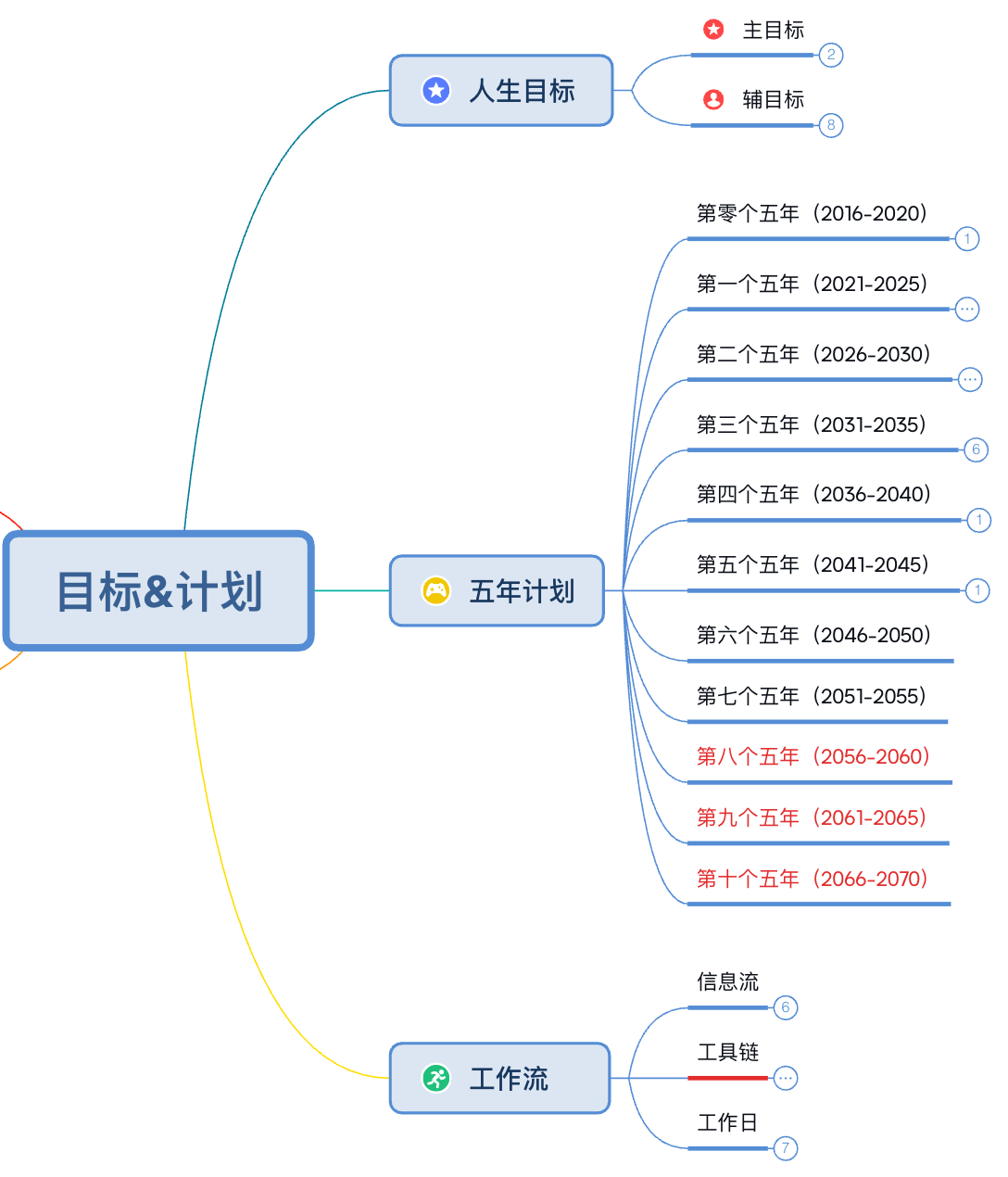
My mind-map’s top-level skeleton — life-goal + ten 5-year plans + workflow methodology.
This matters more for some people than others, and the dimension is not necessarily “how many identities you hold.”
A specialist like Qiu Ye who only does “PowerPoint training” still has time shredded across travel, lectures, building templates, publisher meetings. A research professor wearing only one job title still spends a day across teaching, advising graduate students, writing grants, papers, patent applications, peer review, and conferences — and each of those drains them differently.
I happen to be on both axes — carrying several work-baskets of very different shapes, each containing its own pile of things I personally want to chase; and at the same time being a husband and a father. There is no way to brute-force this. It has to be top-down decomposition.
Without the decomposition, no matter how many baskets you carry, you’ll be dragged through your week by what is urgent but not important. The mind-map is the zoom-out.
4. Choose a Public Goal, Stand on the Same Side as the World
But decomposition isn’t the hardest layer either.
The hardest is one floor up — your life-goal, that “question I want my life to answer” or “the kind of person I want to become” — what is it, exactly?
If I set my life-goal as “become the top expert in autonomous-driving safety” — or, more concretely, “earn the same titles my senior researchers earned: Excellent Young Investigator, Distinguished Young Scholar, Academician” — that’s a perfectly legitimate life-goal in the mainstream academic frame. But it has a quiet side effect: it tends to generate self-blame about not being good enough, and more importantly, it instantiates a population of competitors.
A team at Tsinghua publishes a high-quality paper, ahead of me, on the exact research point I’m focused on → I feel resentment.
A peer lab wins a national grant I had my eye on → I feel deflated.
I’ve been talking to an OEM for several rounds about technical collaboration, sharing piles of materials, and they decide to do the work in-house → I feel like all that prep work was wasted.
These emotions don’t come from the outside world. They come from the nature of the top-level goal. As long as the final scoring rule is “my position relative to others,” these emotions will keep recurring.
Eventually I rewrote the goal: contribute to the safety, health, and comfort of humans in transportation and daily life.

This is a goal of public character — it points at a problem that does not belong to any individual.
A strange thing happened.
That Tsinghua paper comes out → they solved a problem I also wanted to solve, the world is a step closer to my goal, and I’m happy for them.
The OEM does the project in-house → they’re still doing the work, the work is still being advanced. From the public-goal vantage point, they’re allies, not opponents.
I should also be happy for myself — because this is no longer a zero-sum game between “me” and “them.” It’s everyone, in different positions, advancing the same thing.
The benefit of public-goal-ness isn’t that you become “more virtuous.” It’s that your inner state stops fighting the external world.
You no longer spend every day in psychological tug-of-war with imagined competitors. The world starts working for your public goal — and you only have to do your share.
5. In the AI Era, Build the Tool Yourself
Back to the tool question.
The old loop, hunting for time-recording tools: find one → use it for two weeks → friction surfaces → make do → quit halfway → wait six months → look for the next one.
By 2025, the AI shift had broken that loop. The barrier had dropped from “you must be a full-stack engineer” to “you must be able to describe what you want.”
I started building small tools for myself with AI. ROAM (an L4 robotaxi remote-operations platform) and OpenODC (an Operational Design Conditions library for intelligent driving) — both were things I had wanted to build for years and was always blocked by problems like “evaluating the frontend framework alone takes a week.” With AI assistance, I had a first version after a few scattered evenings.
For time management and recording, I also built a small tool, called “Chronicler · 观时者”.
It is not yet another time tracker. What it solves is the complete chain described in the previous three sections — from life-goal all the way down to daily time, with a small piece of AI assistance attached at every layer.
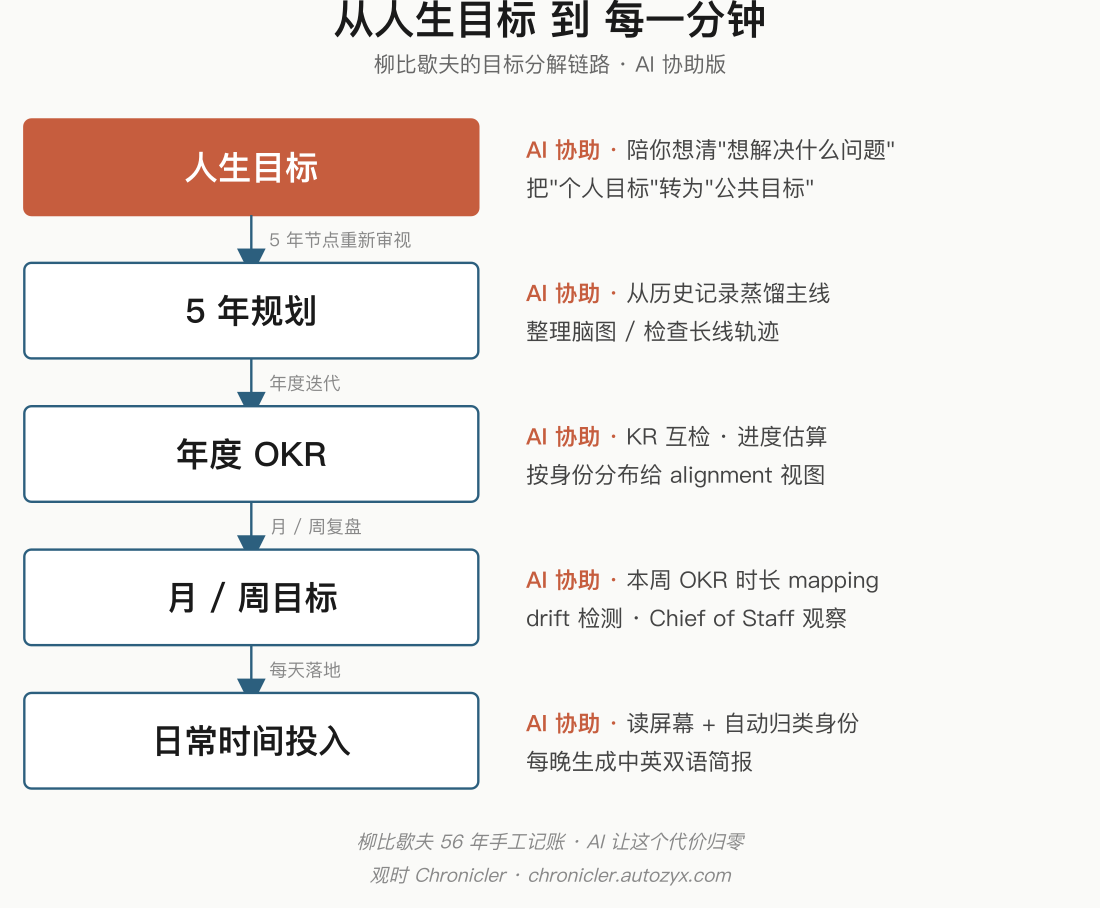
From life-goal to every minute — Lyubishchev’s decomposition chain, AI-assisted edition
The AI assistance at each layer is not complicated:
At the bottom (daily time), AI reads my screen, classifies which identity each segment belongs to, and writes a daily briefing — the thing every previous timer app made me quit over. AI doesn’t need me to press a button.
In the middle (week, month, OKR), AI maps today’s and this week’s time onto my OKR file, points out which Key Result hasn’t been touched in a week and how far the deadline is — the thing that used to be a half-hour manual reconciliation.
At the top (5-year, life-goal), AI helps me distill the through-line out of years of past notes, so I can see what direction I have, in fact, been heading.
The core of Chronicler is not “AI reads your screen.” It’s that the chain of “goal-decomposition + time-against-goal” now keeps running, with AI assistance, without daily discipline as the dependency. Lyubishchev’s 30-minute-a-day cost was the price of running this chain. AI takes that cost to zero.
6. The Tool is the Shell; The Method is the Meat
If you treat Chronicler as “yet another time-tracker,” it’s no different from aTimeLogger.
What it actually does is: keep the decomposition — life-goal → 5-year plan → annual OKR → month/week → daily time on screen — running sustainably, with AI assistance, no daily discipline tax.
For someone juggling many identities and threads, this decomposition is the second-hardest thing — second only to the top-level goal itself.
My own practice is far from clean. The mind-map has been rewritten many times. The OKR is still iterating. Tonight’s email might tell me which KR I haven’t touched in a week, and tomorrow I might still not touch it.
But I can say one thing: for the first time in six or seven years, I have a system in which my goals and my time are in long-running conversation with each other. I no longer pay 30 minutes a day to keep that going. I no longer need a careful weekly review. The system leaves the trace; the AI does the classification; I read a five-minute briefing each night and see myself.
The tool is the scaffold. The scaffold doesn’t matter. What matters is the space the scaffold makes — a space inside which you can finally ask:
The public problem I want my life to address — am I closer to it today than I was yesterday?
7. To Fellow Travelers
This is not a product launch. Chronicler is at v0.1, and won’t be released as open-source for a small group of users until at least the second half of 2026. I have no intention of commercializing it.
I’m writing this because I suspect there are many people who, over the past few years:
- Read A Strange Life, agreed with it, and could not put it into practice
- Installed aTimeLogger / Toggl / Time-block / Notion time-log templates — and quit each one in two or three weeks
- May not have many identities, but under a single hat carry a pile of things that drain them in different ways — and at the end of the day cannot say where the time went
- Have had a vague sense of wanting to “do something with public meaning” — and were dragged back, every day, by what’s actually on the calendar
If you are one of these people, this essay is mostly trying to share two things.
First: in the AI era, when you can’t find the right tool, it might be time to build one yourself. The barrier has dropped from “be a full-stack engineer” to “be able to describe what you want.”
Second: more important than the tool is the nature of your top-level life-goal — is it personal (become the top expert in field X), or is it a public problem (help more people benefit as the field advances)? The first puts you in daily psychological tug-of-war with imagined competitors. The second puts the world on your side.
What Lyubishchev quietly passed down was not the discipline of 56 years of accounting. It was that he chose a class of problems that didn’t belong to him personally, and worked on them for 56 years.
How to practice A Strange Life? Use AI to drop the 30-minute daily cost to zero, and let the decomposition chain be supported at every layer.
How to live out A Strange Life? Take a public problem — one that’s not just yours — and treat it as your own, for decades.
Related links · chronicler.autozyx.com · github.com/AutoZYX/chronicler · Originally published in Chinese on the WeChat channel “张玉新-AutoZYX” · Collected under “The Third Exploration” · Personal opinions, for reference only