Abstract: Yoav Hollander is a world-class expert in chip verification. The company he founded, Foretellix, brought coverage-driven verification (CDV) into autonomous driving. Recently he wrote a post pushing the methodology into a much larger arena: AI alignment. This post reads that cross-domain migration from my own research field — the SOTIF four-quadrant model, the tree-like structure of Robot SOTIF, and the standards-driven Chinese context. The core question stays the same throughout: how do you know what you don’t know?
A few months ago, Yoav Hollander (co-founder and CTO of Foretellix) sent me an email.
He is a world-class expert in chip verification. He invented the “e” language, the predecessor of the Universal Verification Methodology (UVM). After Verisity, the company he founded, was acquired by Cadence, he started Foretellix — applying coverage-driven verification (CDV) to autonomous driving, with a Series C extension backed by investors including NVIDIA, Volvo, and Temasek.
Yoav had read several of my articles on end-to-end safety, scenario-based evaluation, and SOTIF. We talked through a few rounds of email and video calls. Recently, he wrote a post that pushes the question into a much larger arena: AI alignment.
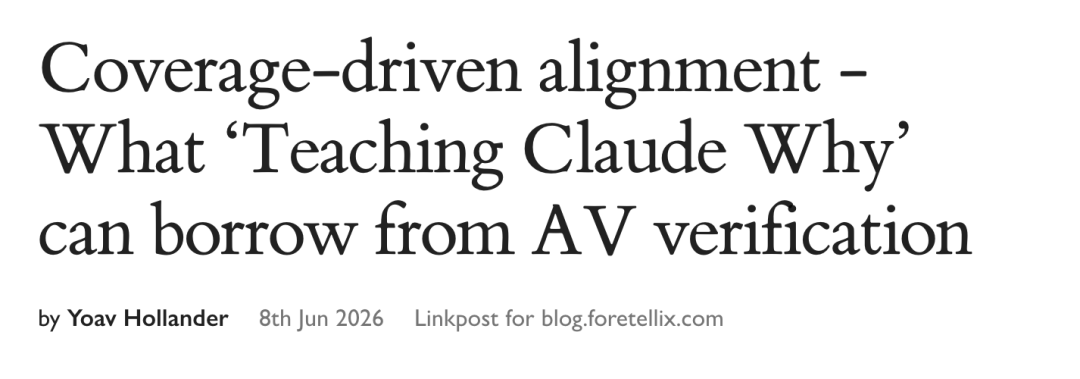
With Yoav’s permission, I translated the post into Chinese (read the translation here). The original is here: Coverage-driven alignment – What ‘Teaching Claude Why’ can borrow from AV verification.
What follows is my own reading and extension of CDV’s cross-domain migration — grounded in how SOTIF actually works, and in what CDV means in the Chinese context.
Where Two Lines Meet
Yoav wrote one line in his email that stuck with me:
“I am at heart a V&V guy, thinking about ‘how to achieve best risk reduction per week for the SUT, given fixed resources’. I feel much less confident regarding safety standards and ‘how to build a safety case’.”
The difference between the two lines is clear. He is a V&V person: given fixed resources, how do you achieve the largest risk reduction per week? I lean toward safety-standard-based development and testing, building toward a safety case. One line is about how to find problems; the other is about how to prove the problems have been solved.
But projected onto an end-to-end black box, both are ways of casting a safety structure over opaque behavior. Yoav projects with coverage dimensions; I project with scenarios and triggering conditions. CDV is where these two lines meet.
The SOTIF Four Quadrants: What CDV Is Measuring
The SOTIF framework divides scenarios into four quadrants:
| Known | Unknown | |
|---|---|---|
| Safe | Quadrant 1: known safe | Quadrant 2: unknown but safe |
| Unsafe | Quadrant 3: known unsafe | Quadrant 4: unknown unsafe |
Every CDV operation corresponds to a move between quadrants:
- Evaluate → turn unknown into known (Quadrant 2→1, or 4→3)
- Fix → turn known-unsafe into safe (Quadrant 3→1)
- Coverage map → see the area and distribution of each quadrant
- Iterate → keep shrinking Quadrant 4
The ultimate goal of SOTIF is not to eliminate all risk, but to compress Quadrant 4 into an acceptable range. CDV is the instrument for shrinking Quadrant 4 — it keeps finding and removing pieces of it. A caveat (which Yoav rightly pressed me on): CDV cannot really measure the remaining Quadrant 4, which stays unknown by definition. What we can do is watch the discovery rate — whether it flattens off despite our best techniques — and use that to convince ourselves indirectly that what remains is small enough, then build a defensible safety argument on top. That is a convergence heuristic, not a measurement.
This correspondence is not retrofitted. The SOTIF framework of ISO 21448 and the coverage map of CDV are, at bottom, answering the same question: how do you know what you don’t know?
The Tree-Like Structure of Robot SOTIF
Yoav wrote another key line in his email:
“One problem with robots is that they are much more diverse than AVs, so V&V in general (and the SOTIF part of it) get a tree-like structure.”
That tree-like structure is precisely the core difference between Robot SOTIF and automotive SOTIF.
The coverage dimensions of autonomous driving are relatively fixed — weather, roads, traffic participants. Robots are different. On June 2, 2026, the Chinese national standard project Implementation Guidelines for Robot SOTIF (机器人预期功能安全实施指南) entered public notice. The standard faces not one kind of robot but an entire branching tree: mobile service robots, cleaning and disinfection robots, security patrol robots, logistics delivery robots, elder-care and medical robots… Each kind has its own ODD (Operational Design Domain), scenario set, and triggering conditions.
If you follow robot-related standards: the National Technical Committee on Robotics Standardization currently has 82 national standards in drafting for all kinds of robots, of which 17 are strongly safety-related.
This fits naturally with the Layered CDV that Yoav proposes:
- Layer 1: generic framework verification — verify the base model’s fundamental safety capabilities, with generic coverage dimensions such as environment, task, and user behavior
- Layer 2: task-specific verification — add coverage dimensions on top of the generic framework; a delivery robot, for example, adds dimensions like “approach behavior” and “yielding strategy”
- Layer 3: deployment-specific verification — add dimensions for the concrete deployment; a delivery robot in a particular hospital adds dimensions like “ward access control” and “elevator interaction”
Each layer inherits the coverage map of the layer above and only adds its own dimensions and scenarios. This is exactly why the verification structure of Robot SOTIF has to grow from a plane into a tree.
From Autonomous Driving to AI Alignment: The Imitation-Learning Bottleneck
Yoav’s post contains an insight that matches what I have observed in my Robot SOTIF open-topic research:
Anthropic training Claude and NVIDIA building autonomous driving discovered the same thing at almost the same time — imitation learning cannot handle safety-critical scenarios. Behavioral shaping or imitation alone is not enough; you have to teach the reasoning behind the behavior.
- Anthropic’s finding: teaching reasoning principles through constitutional documents (Claude’s Constitution) and fictional stories — what they call SDF — cut misalignment by 3x+, far better than pure RL behavioral shaping. The biggest lever was not showing the right behavior, but teaching the why behind the behavior.
- NVIDIA’s finding: imitation learning cannot cope with long-tail scenarios; their solution is structured causal reasoning (Chain of Causation).
One is called SDF in AI alignment; the other is called Chain of Causation in autonomous driving. The core lever is the same — not demonstrating the right behavior, but teaching the why behind it.
Mapped onto Robot SOTIF, this means robot safety cannot rely only on “teaching the robot the right moves”. The robot also has to understand why a move is safe in the current scenario. An LLM/VLA-driven decision system that can only imitate but not reason will fail beyond its ODD boundary.
CDV in the Chinese Context: From Standards to Practice
CDV’s diffusion in the Chinese context has a distinctive entry point: it is standards-driven.
A particular feature of China’s autonomous-driving safety field is that standards often run ahead of industrial practice. GB/T 43267-2023 (Road vehicles — Safety of the intended functionality) has been published; a series of safety standards for specific intelligent-driving functions are being drafted at full speed; and the Robot SOTIF national standard project has entered public notice. These standards establish the SOTIF four-quadrant structure and evidence-chain requirements at the framework level — but on the question of how to systematically discover unknown-unsafe regions, they leave a great deal of room to engineering practice.
CDV fills exactly that space.
Concretely, there are several directions worth pushing:
Connecting scenario libraries to coverage maps. China already has substantial scenario-library construction (including the 800h+ of drone-based naturalistic driving data, 10.5M+ trajectories, collected by the team I work with). But these scenario assets are mostly used as test cases today; they have not been systematically mapped onto coverage dimensions. CDV’s coverage-map framework can turn a scenario library from “a pile of test cases” into “an iterable risk map”.
A layered verification template for Robot SOTIF. Automotive SOTIF has the scenario-abstraction frameworks of ISO 21448 and ISO 34502; Robot SOTIF has no equivalent scenario taxonomy or triggering-condition system yet. The tree structure of Layered CDV can serve directly as the organizing frame for Robot SOTIF verification — a generic layer, a task layer, and a deployment layer, each with its own coverage dimensions and scenario sets.
Closing the loop between safety cases and coverage maps. Yoav says he is a V&V person and less at home with safety cases. I am the other way around. CDV’s coverage map and per-bucket residual-risk estimates are natural evidence sources for a safety case — in the claim–argument–evidence structure, the coverage map supplies evidence, residual risk supplies argument, and the deployment decision is the claim.
The Incentive Gap in Alignment: Who Pays for Expensive Verification?
At the end of his post, Yoav raises a very practical question: autonomous driving has regulatory pressure, accident investigations, and legal liability, so systematic verification is rational. What is the equivalent external pressure for AI alignment?
The question exists in the Chinese context too — but there may be a different path.
China is building out an AI governance framework, including algorithm registration and security assessment regimes. If the coverage maps and risk assessments produced by CDV can become evidence of “reasonable care” — just like safety cases in autonomous driving — then alignment V&V gains an institutional incentive base.
Yoav asked me in email whether I know people in AI governance who should see his post. If you are reading this and work in AI governance, algorithm safety assessment, or a related field, I would be glad to talk.
Something That Started with One Email
Yoav joked in his email: “I guess I write a post-per-year, while you write a post-per-week.” But the one post he writes each year always carries weight.
From automotive SOTIF to Robot SOTIF to AI alignment, the CDV methodology is migrating across domains. Not by copy-paste, but with problem awareness intact — each domain has different dimensions, a different tree structure, a different boundary between safety and security.
The core question, though, stays the same: how do you know what you don’t know?
I invited Yoav to speak at the SOTIF session of this year’s FISITA Intelligent Safety Conference (ISC 2026 preliminary agenda, in Chinese). His confirmed title is Avoiding Spec Bugs in Physical AI. A spec bug is not an implementation failure — it is a region the spec itself never covered. Autonomous driving has already paid the price for this; robotics is on its way to repeating it; AI alignment will probably be no exception.
CDV is not a panacea. But it at least gives us a systematic way to find spec bugs — by coverage, not by luck.
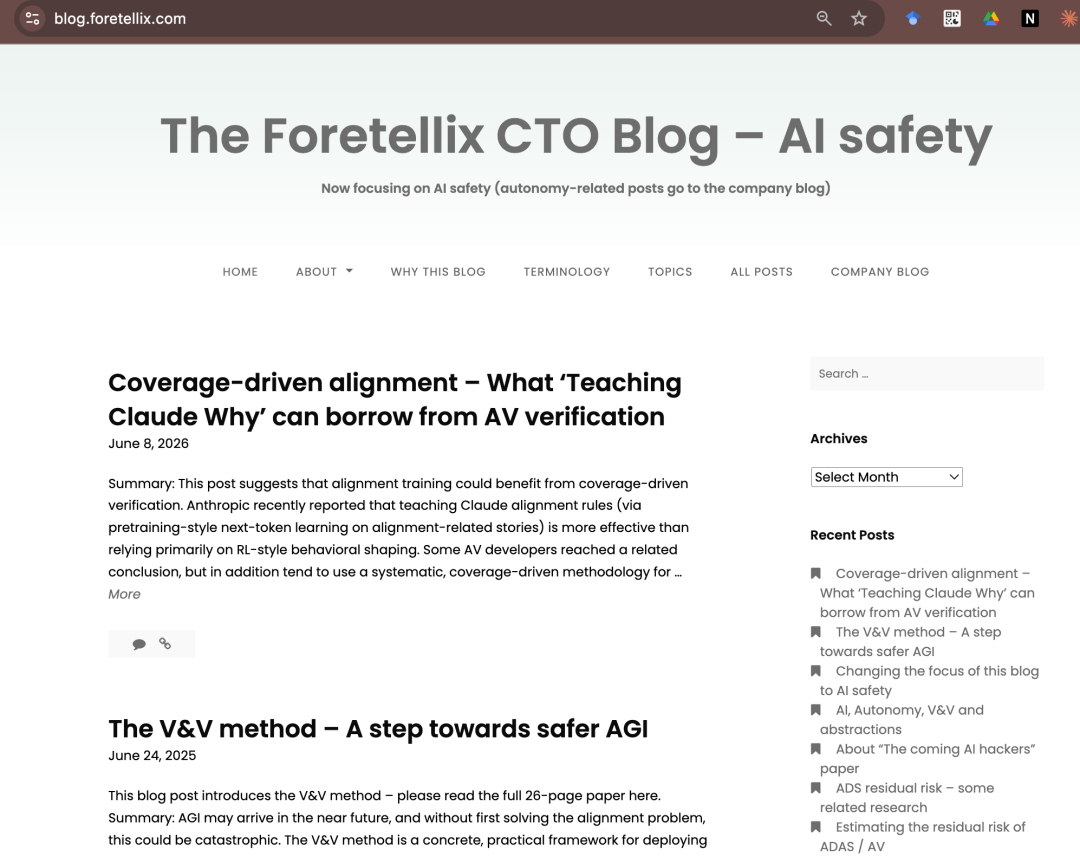
If you care about AI safety, follow Yoav’s The Foretellix CTO Blog. Every post is a classic.
Previous Posts
- Robots Need SOTIF Too
- Does Intelligent Driving Need an Open Platform for Operating Boundaries?
- When the Robotaxi Fails, Who Catches It?
- Harness Engineering: User Experience vs Safety Compliance — A Direction Mainstream Roadmaps Have Collectively Skipped
- Applying Harness Engineering to Intelligent Driving
- From ‘Human’ Driving to ‘Human-like’ Driving
Sources:
- Yoav Hollander: Coverage-driven alignment – What ‘Teaching Claude Why’ can borrow from AV verification
- Anthropic: Teaching Claude Why
- NVIDIA Alpamayo-R1: Chain of Causation reasoning (arXiv:2511.00088)
- National Public Service Platform for Standards Information: project notice for 机器人预期功能安全实施指南
- GB/T 43267-2023 道路车辆 预期功能安全
- ISO 21448:2022 Road vehicles — Safety of the intended functionality